




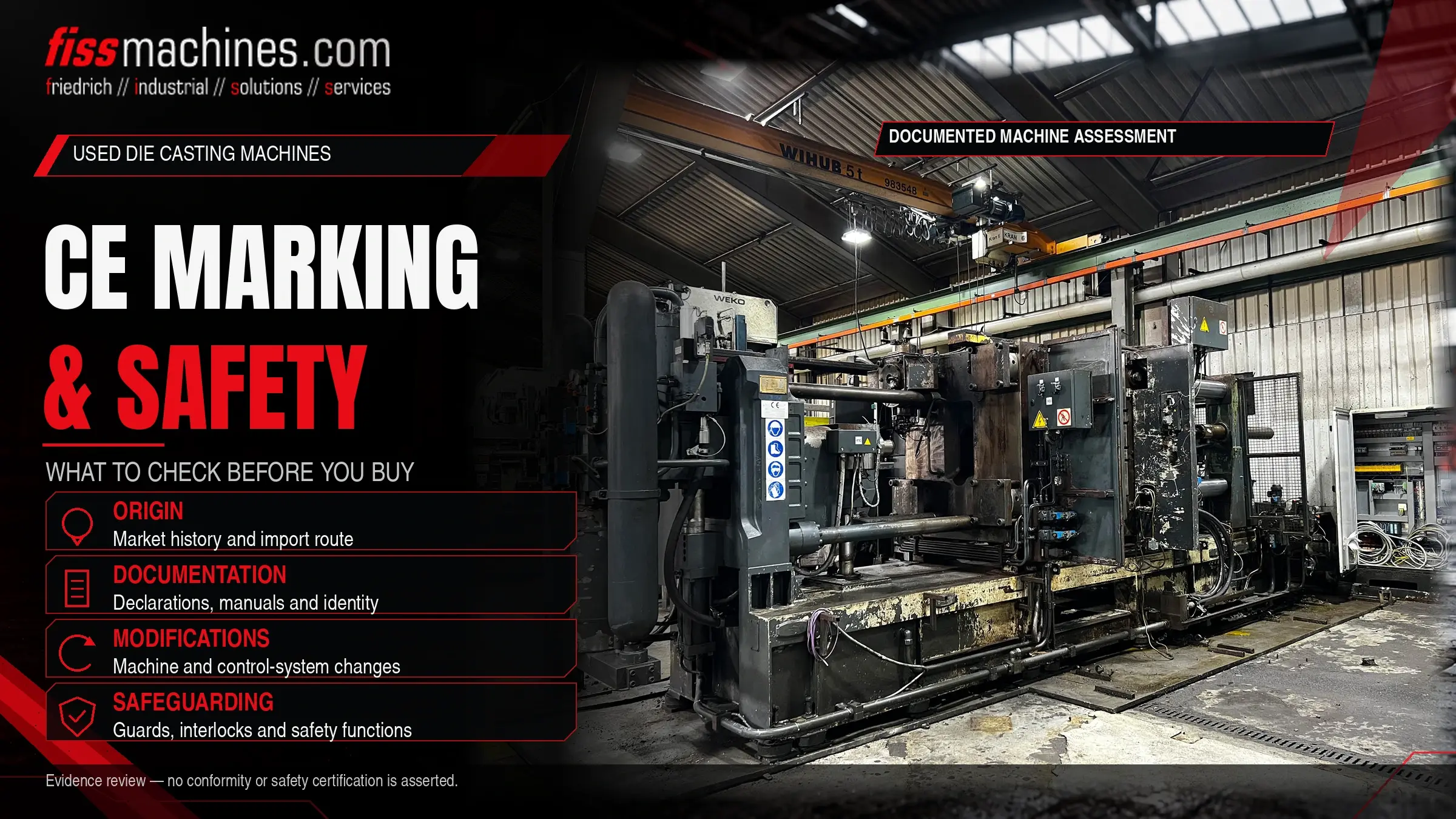
CE Marking and Safety When Buying a Used Die Casting Machine
With a used die casting machine, the buyer acquires not only technology but also responsibility. Whether a new CE marking is required, which standard applies and what changes with the EU Machinery Regulation in January 2027 depends mainly on two questions: where does the machine come from, and what will be changed on it?
Does a Used Die Casting Machine Need a New CE Marking?
A machine that was already placed on the EU market as a new machine does not need a new conformity assessment simply because it is resold. The operator must nevertheless ensure that it is safe to use at the new workplace.
It is different for machines imported from a third country outside the EU and placed on the Union market for the first time: according to the European Commission’s Blue Guide, EU product legislation then applies as for a new product – even if the machine was built before the rules came into force. A substantial modification can also trigger new manufacturer obligations.
Three Typical Situations
| Situation | What Applies | Practical Consequence |
|---|---|---|
| Machine from within the EU, resold unchanged | No new placing on the market; operator obligations for work equipment | Safety review at the new site, documentation from the seller |
| Machine imported from a third country | EU product legislation applies when it is placed on the Union market for the first time | Conformity assessment, technical documentation, declaration of conformity and CE marking required |
| Machine substantially modified | The person carrying out the modification can take on manufacturer obligations | Assess the scope of modification and plan the conformity procedure early |
Already on the EU Market: Operator Obligations Apply
EU harmonisation legislation such as the Machinery Directive applies when a product is placed on the Union market for the first time. A die casting machine that was placed on the market as a new machine in the EU does not have to undergo a new conformity assessment just because it changes owners.
However, the operator must ensure that the machine can be used safely at its workplace. The basis is Directive 2009/104/EC on the use of work equipment, implemented in national law – in Germany, for example, by the Ordinance on Industrial Safety and Health (BetrSichV). In practice, this means a risk assessment for the specific workplace, functioning safety devices and trained personnel.
Buyers should ask the seller for the original declaration of conformity, the operating manual and the circuit diagrams. If they are missing, it becomes much more difficult to assess the original safety concept.
Imported from Outside the EU: Treated Like a New Machine
The European Commission’s Blue Guide on the implementation of EU product rules (2022) states that Union harmonisation legislation also applies to used and second-hand products imported from a third country when they enter the Union market for the first time – even if they were manufactured before the legislation became applicable.
For a die casting machine from Asia or America, for example, this means: before it is placed on the market in the EU, it must meet the essential health and safety requirements of the applicable machinery legislation. This requires a risk assessment, technical documentation, an EU declaration of conformity, CE marking and instructions in the language of the country of use.
Upgrades Often Needed
Guards, interlocks, control safety functions or emergency stop concepts frequently have to be adapted to European requirements.
Documentation Effort
Diagrams, manuals and technical files are often incomplete or not available in the required language.
Part of the Calculation
The effort for the conformity procedure belongs in the purchase calculation – it can significantly change the comparison with an EU machine.
From 20 January 2027: Regulation (EU) 2023/1230
The Machinery Directive 2006/42/EC will be replaced by the Machinery Regulation (EU) 2023/1230, which applies from 20 January 2027. As a regulation, it applies directly in all member states. Machines placed on the market or put into service from that date must meet its requirements; machines lawfully placed on the market before that date do not have to be recertified.
For buyers of used machines, the explicit rule on substantial modifications is particularly relevant: a physical or digital modification that was not foreseen by the manufacturer and that creates a new hazard or increases an existing risk in such a way that new protective measures are required. Under Article 18, whoever carries out such a modification is considered a manufacturer with the corresponding obligations. Changes to control software can also be a substantial modification.
This matters for retrofits of controls and safety functions. How overhaul and retrofit differ technically is described in Overhaul or Retrofit?
EN 869 Has Been Replaced by EN ISO 23063
Évtizedek óta az EN 869 volt európai biztonsági szabvány a nyomásos fémöntőegységekhez. AEN 869:2006+A1:2009 verziót 2025-ben visszavonták, és helyébe EN ISO 23063:2025 “Foundry machinery – Safety requirements for high pressure die casting machines” (ISO 23063:2024) lépett.
Az EN 869 lefedte aöntőgépet és annak interfészeit az öntőformával,/furnálárisokkal, fémenedékkel, darab eltávolításával, spray-piaci berendezésekkel és öntőhőmérséklet-szabályozó egységekkel – de nem a kiegészítő berendezést magát – és kizárta az alacsony nyomású és gravitációs öntőgépeket. Szemléltető területei jól tájékoztatják a vásárlókat:
- Öntőterület: védőburkolatok, reteszek és védőelemek a záródó mozgások ellen
- Forró fém: védelem a fémszóródás és a rés során a fém kiszabadulása ellen
- Hidraulika: accumulátorok, csövek, nyomáscsökkentés és tűzálló folyadékok
- Interfészek: robotok, permetező egységek, kivonó- és fűtőberendezések cellájában
- Vezérlés: biztonsági funkciók, vészleállítás és üzemmódok beállításához/karbantartásához
Hogy egy szabvány feltételezett megfelelést ad-e, attól függ, hogy az adott projektben hivatkozzák-e az EU Hivatalos Lapjában. Ezt az állapotot a konkrét projekt esetében kell ellenőrizni.
Amit a vásárlóknak tisztázniuk kell szerződéskötés előtt
- A gép eredete: forgalmazás az EU piacán, vagy harmadik országból származó import?
- Megfelelőségi nyilatkozat, CE jelöléssel ellátott típuslemez, üzemeltetési útmutató megfelelő nyelven
- Hidraulikus és elektromos diagramok, a gyártó kockázatértékelése, ha rendelkezésre áll
- Módosítások története, retrofikációk és vezérlési változtatások
- Védőburkolatok, reteszek, fényfüggönyök és vészleállító áramkörök állapot
- Tervezi-e a változtatásokat az új telephelyen, és ezek lehetnek-e lényegiek
- Felelősségek adatszerűen a eladó, a vevő, az integrátor és a kezelő között – írásban
Általános technikai szempontok a sokszor végzetes ellenőrzéshez a Használt öntőgép vásárlási ellenőrzőlista című oldalon találhatók. A FISS a vevőket szintén támogatja tanácsadás és biztonságos üzembe helyezés terén.
Eredet és változások tisztázása korán
Használt öntőgépek esetén a CE jelölés kérdése kevésbé a kor alapján, inkább az eredet és a változtatások alapján dől el. Az EU piacról származó gépek esetében főként a kezelő által végzett biztonsági átvilágítás szükséges. Harmadik országokból származó import és jelentős módosítások esetén teljes megfelelőségi eljárás indítható – a 2027. január 20-i hatálybalépésű Gépjármű Készülék Rendelet új jogi alapként szolgál. A vásárlás előtti tisztázás megelőzi a költség és ütemterv meglepetéseit.
Kérdések a CE-megfelelésről és a használt öntőgépekről
Igényel-e a Németországból származó Használt Öntőgép új CE- megjelölést?
Nem, ha új gépként került forgalomba az EU piacon és változatlanul értékesítik. Az új üzemeltetőnek azonban biztosítania kell a munkahelyi biztonságos használatot és el kell végeznie a szükséges kockázatértékelést.
Milyen változások történnek 2027. január 20-án?
A 2023/1230/EU rendelet felülírja a Gépjármű Rendeletet. Attól a dátumtól forgalomba kerülő vagy üzembe helyezett gépeknek meg kell felelniük a Rendeletnek. Egyúttal kifejezetten meghatározza a lényeges módosításokat is.
Érvényes-e még az EN 869?
Az EN 869:2006+A1:2009 2025-ben visszavonták és helyébe az EN ISO 23063:2025 lépett. Öregebb gépeket gyakran az EN 869 szerint építettek, amely továbbra is releváns a biztonsági koncepció megértése szempontjából.
Vagyonezés (felújítás) CE-kompatibilissé teszi-e a gépet?
Nem. A felújítás a műszaki állapotot helyreállítja, de nem helyettesíti a megfelelőségi értékelést. Ha biztonsági funkciók változnak, ellenőrizni kell, hogy a módosítás lényeges-e.
Gép kiválasztása a biztonság szem előtt tartásával.
A FISS használt öntőgépeket ismert eredettel és dokumentációval szállít, és támogatja a vevőket tanácsadással, szállítással és üzembe helyezéssel. Kérdezze meg időben az érdeklődő gépről.
Források
Európai Bizottság: The “Blue Guide” on the implementation of EU product rules 2022, OJ C 247, 29.6.2022, 2.1-es és 2.5-ös szakaszok (Termékek fedezete és EUn kívüli országokból importált termékek).
Regulation (EU) 2023/1230 of the European Parliament and of the Council on machinery (Machinery Regulation), alkalmazás 2027. január 20-tól; Art. 3(16) és Art. 18 (lényeges módosítás). Összegzés: Noerr, Regulation (EU) 2023/1230 on machinery.
Directive 2009/104/EC a munkaeszközök használatára vonatkozó minimális biztonsági és egészségügyi követelményekről a munkában lévő dolgozók számára.
EN 869:2006+A1:2009 Safety of machinery – Safety requirements for pressure metal diecasting units – scope (BSI Knowledge); státusz „withdrawn”, helyette EN ISO 23063:2025 (Estonian Centre for Standardisation, EVS).
EN ISO 23063:2025 Foundry machinery – Safety requirements for high pressure die casting machines (ISO 23063:2024).
