




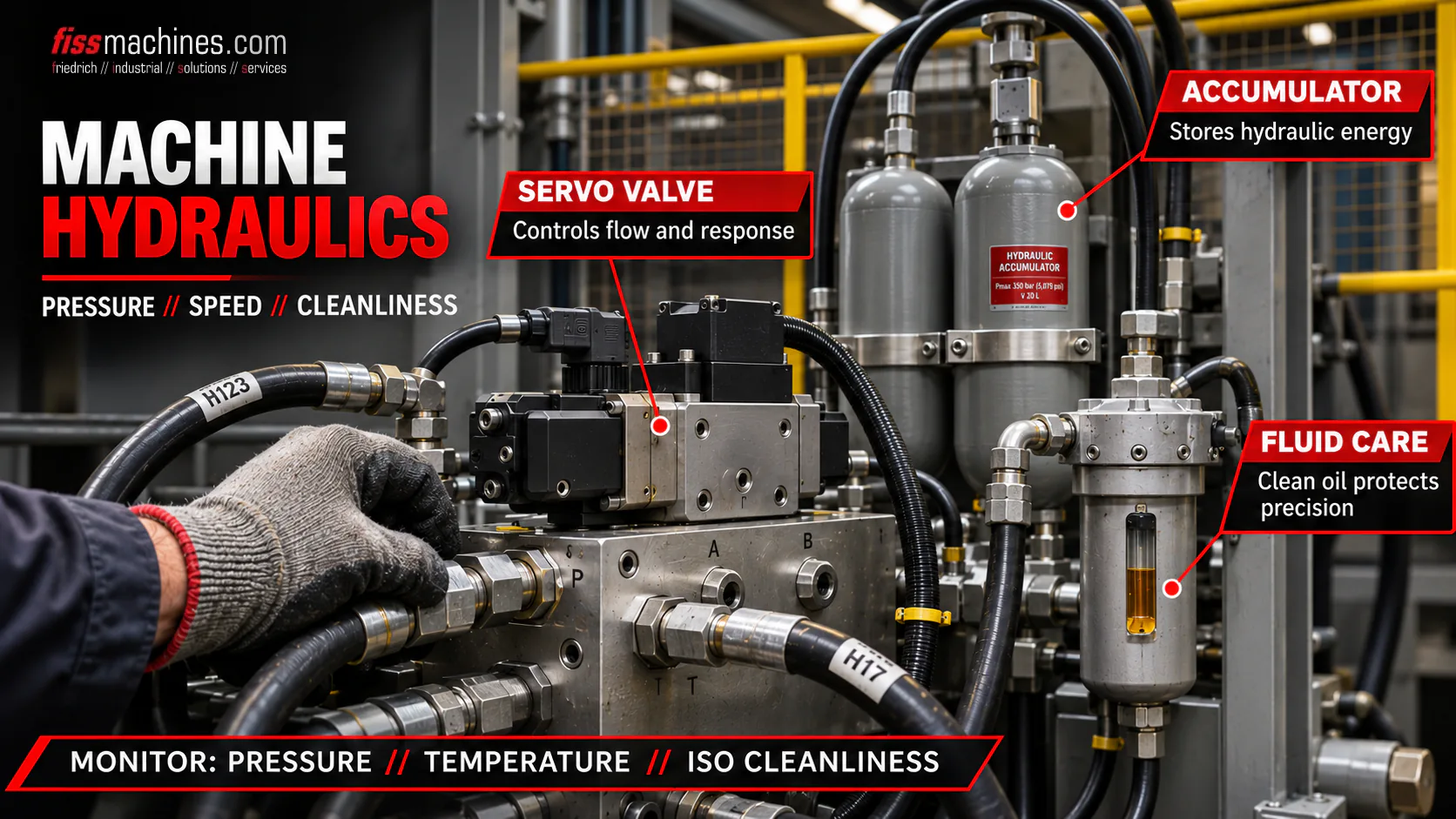
Hydraulics of Die Casting Machines: Servo Valves, Accumulators and Fluid Care
A cold-chamber die casting machine takes the plunger from slow pre-fill to fast shot and intensification within fractions of a second – all driven by hydraulics. When valves, accumulators or the fluid deteriorate, the process drifts long before the machine stops.
What Does Die Casting Machine Hydraulics Include?
Die casting machine hydraulics is the fluid power system that closes and locks the die, drives the shot plunger through its phases, builds up intensification pressure and moves ejectors and core pulls. Its core components are pumps, nitrogen-precharged piston accumulators, servo or proportional valves, cylinders and the hydraulic fluid.
Shot speed and repeatability depend directly on these components – and on fluid type, temperature and cleanliness.
The Hydraulic Circuits of a Cold-Chamber Machine
A cold-chamber machine has several hydraulic circuits with very different requirements: some need high force at low speed, others extreme flow for milliseconds. The overview shows a typical structure; details differ between manufacturers and machine generations.
| Circuit | Task | Typical Components | Typical Signs of Wear |
|---|---|---|---|
| Clamping | Close, lock and open the die | Clamping cylinder, toggle or locking cylinders, valves | Slow movements, pressure loss when locked |
| Injection | Slow phase, fast shot, braking | Shot cylinder, servo or proportional shot valve, accumulator | Lower or unstable fast-shot speed |
| Intensification | Pressure build-up after filling | Multiplier, accumulator, check valves | Slow pressure rise, decay during dwell |
| Ejectors and cores | Eject casting, move slides | Ejector and core-pull cylinders, end-position switches | Sluggish movement, end-position faults |
| Power unit | Supply, filter and cool the fluid | Pumps, tank, filters, cooler | Noise, high temperature, clogged filters |
How the phases appear in the shot curve is explained in Understanding Shot Curves; demand-based pump drives are covered in Energy Efficiency in Die Casting.
Servo and Proportional Valves: The Shot Valve Sets the Speed
The shot valve meters the oil flow from the accumulator into the shot cylinder and thus sets plunger speed and phase transitions. With real-time shot control, the control compares actual and set movement during the shot and corrects the valve opening within the same shot. Bühler describes its injection unit as providing “real-time closed-loop control, automatically reacting to deviations” (manufacturer statement, Carat product page). Machines without real-time control use fixed valve settings and only record the result.
Highest Dynamics
Very fast response and fine resolution in closed-loop circuits. Tight spool clearances make it sensitive to contamination.
Robust and Versatile
Flow and pressure control on many axes. Versions with a closed-loop pilot stage are designed for high dynamics.
Moog lists die casting among the applications of its D680 proportional valve series (manufacturer statement, press release of 1 October 2018). Whatever the type, the valve’s condition shows directly in the shot. FISS offers general overhaul and repair of Moog servo and proportional valves for die casting machines as a partner service.
Piston Accumulators: Stored Energy for the Fast Shot
No pump delivers the flow of the fast shot directly. The energy comes from piston accumulators: fluid and gas sections separated by a piston, the gas side precharged with dry nitrogen. HYDAC names high flow rates and large oil volumes as typical uses and offers piston position sensors for volume monitoring. Back-up nitrogen bottles enlarge the gas volume.
The machine manufacturer specifies the nitrogen pre-charge to match the working pressures. Because gas pressure changes with temperature, readings should be compared at defined temperatures. Check intervals are summarised in Preventive Maintenance of Die Casting Machines.
Fire-Resistant Hydraulic Fluids: HFC, HFDU and HFDR
Because a leak near liquid metal is a fire risk, many die casting machines run on fire-resistant hydraulic fluids. ISO 6743-4 (2015 edition) classifies, among others, HFC (water polymer solutions), HFDR (water-free phosphate esters) and HFDU (water-free synthetic fluids of other composition). According to Quaker Houghton, water-glycol HFC and polyol ester HFDU are the most widely used in die casting.
Water-Glycol
Typically more than 35 % water, which provides fire resistance. Water content must be monitored.
Water-Free Synthetic
Often polyol esters. No water to manage; Quaker Houghton cites a high fire point.
Phosphate Ester
Water-free. Material compatibility must be clarified with the suppliers.
An ExxonMobil overview based on ISO guidance gives typical operating ranges up to about +50 °C for HFC and +70 °C for HFD fluids. Quaker Houghton recommends sampling HFC at least every three months and HFDU every six months (manufacturer statement). Fluids of different categories must not be mixed – water-based and water-free fluids form two layers – so a change of category requires draining, flushing and checking seals and hoses.
Hydraulic Oil Cleanliness According to ISO 4406
Particles wear metering edges, make spools stick and increase internal leakage. ISO 4406:2021 codes cleanliness as three scale numbers for particles ≥ 4, ≥ 6 and ≥ 14 µm(c) per millilitre, e.g. 18/15/12; one step roughly doubles the count. A Moog datasheet for the D633/D634 series (Rev. 2, 2009) recommends better than 15/12 (older two-number code) for normal operation and 14/11 for longer life, with a high-pressure filter without bypass upstream of the valve.
- Sample from the same point at fixed intervals and read results as a trend
- Compare the code with the target of the most sensitive valve
- Change filters by differential pressure, using specified elements
- Keep fluid temperature within the approved range
- Keep the tank closed, fill only via filters, repair leaks promptly
Hydraulic Faults: A Diagnosis Sequence
Typical early signs of hydraulic problems are lower fast-shot speed at unchanged settings, slower intensification, more scatter or rising fluid temperature. This illustrative sequence – not a manufacturer procedure – helps narrow down the cause.
Measurement Chain
Transducers, cabling and data settings – a loose sensor can mimic a hydraulic fault.
Fluid
Temperature, cleanliness code, water content (HFC), filter indicators.
Accumulators
Pre-charge and accumulator pressure before the shot; nitrogen loss reduces fast-shot speed.
Valves and Cylinders
Valve response, spool position signal, internal leakage, check valves, seals.
Pumps and Shot End
Pump delivery and noise; plunger and sleeve friction.
Rising friction between plunger and sleeve looks similar to a hydraulic loss of power – see Shot Sleeves and Plungers in Cold-Chamber Die Casting.
Hydraulics When Buying or Overhauling a Used Machine
On a used die casting machine, the hydraulics show how it has been treated. Useful evidence: fluid analyses, fluid type, accumulator records, production shot curves and the condition of seals and hoses. More points are listed in Buying a Used Die Casting Machine: The Technical Checklist; when an overhaul pays off is discussed in Overhaul or Retrofit?
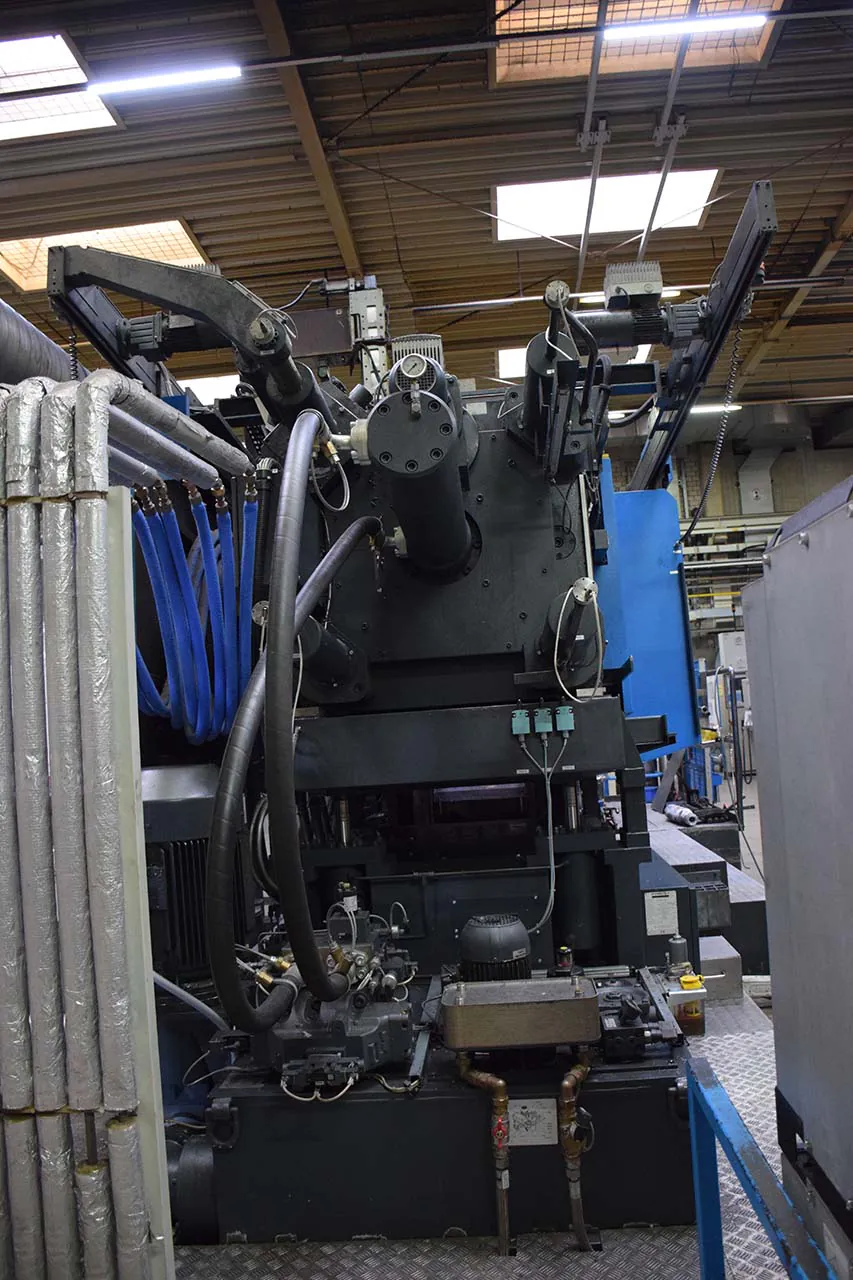
Hydraulics Decides the Quality of the Shot
Die casting machine hydraulics combines high forces with extremely fast flow changes. Those who keep fluid type, temperature and cleanliness under control, check accumulators regularly and compare shot data with references recognise drift early – and can plan valve repairs or overhauls before they cost production.
Questions About Die Casting Machine Hydraulics
Why Do Die Casting Machines Use Fire-Resistant Hydraulic Fluids?
A leaking line near liquid metal can ignite mineral oil. Fire-resistant fluids such as HFC or HFDU are harder to ignite and reduce this risk, but they are not fireproof and need their own monitoring.
What Does an ISO 4406 Code Like 18/15/12 Mean?
The numbers stand for the particles per millilitre of at least 4, 6 and 14 µm(c). Lower numbers mean cleaner fluid. The target depends on the most sensitive component, usually the servo or proportional valve.
How Does Low Accumulator Pre-Charge Show Up?
Usually as a gradual drop in fast-shot speed and slower pressure build-up at unchanged settings. Comparing with reference shot curves makes it visible.
Is It Worth Repairing a Servo Valve?
Often yes: a general overhaul can restore a high-value valve and is an alternative to buying new. It depends on valve type, condition and the quote compared with a replacement.
Valve Repair and Machine Overhaul with FISS.
FISS overhauls used die casting machines and, as a partner service, repairs Moog servo and proportional valves. Contact us to discuss your hydraulics.
Sources
ISO 6743-4:2015 – Lubricants, industrial oils and related products (class L) – Classification – Part 4: Family H (Hydraulic systems), third edition (preview).
ISO 4406:2021 – Hydraulic fluid power – Fluids – Method for coding the level of contamination by solid particles, fourth edition (preview).
Moog: D633 and D634 Series Direct Drive Servo-Proportional Control Valves, Rev. 2, 04/2009; press release on the D680 series, 1 October 2018, accessed 6 November 2026.
HYDAC: Piston Accumulators, online catalogue; Hydraulic accumulators with back-up nitrogen bottles, EN 3.553.7/05.24, accessed 6 November 2026.
ExxonMobil: Fire-Resistant Fluids – Conversion and Compatibility, 2023, accessed 6 November 2026.
EUROGUSS 365: R. Knecht (Quaker Houghton), The Real Force Behind High-Pressure Die Casting, accessed 6 November 2026.
Bühler: Carat die-casting machine, product page, accessed 6 November 2026.
FISS Machines: service Reconditioning, fiss-machines.com, accessed 6 November 2026.
